
AI Model Distillation 2026: Why Every Lab Distills Now + What Builders Should Use
The Quiet Shift Reshaping the Model Market
Two years ago, “distillation” was a footnote in research papers. A clever trick for shrinking a model when you couldn’t afford the full version. Fast forward to October 2026 and the conversation has flipped: every major lab is now distilling its own frontier models on purpose, and a lot of the geopolitical tension in AI is about who is distilling whose. OpenAI shipped GPT-5.4 Mini and Nano in March as the default cheap tier. Anthropic has Claude Haiku running internally on distillation pipelines that quietly shadow every Claude Sonnet release. DeepSeek’s entire R1 family is a distillation story. And Jensen Huang, asked in September whether distillation by competitors counts as unfair competition, gave a one-word answer: “competition.”
This post is for the people who actually build with these systems. Not the people arguing about IP. The builders choosing a model for a customer-support agent, a code-completion feature, a real-time voice pipeline. Distillation is no longer something you do because you can’t afford the frontier. It’s the strategic move that determines which models win the next two years — and the playbook for using them is not what most tutorial content suggests.
What Distillation Actually Looks Like Now
Old distillation: take a big teacher model, train a small student to mimic its outputs, save on inference cost. New distillation is messier, more strategic, and far more political.
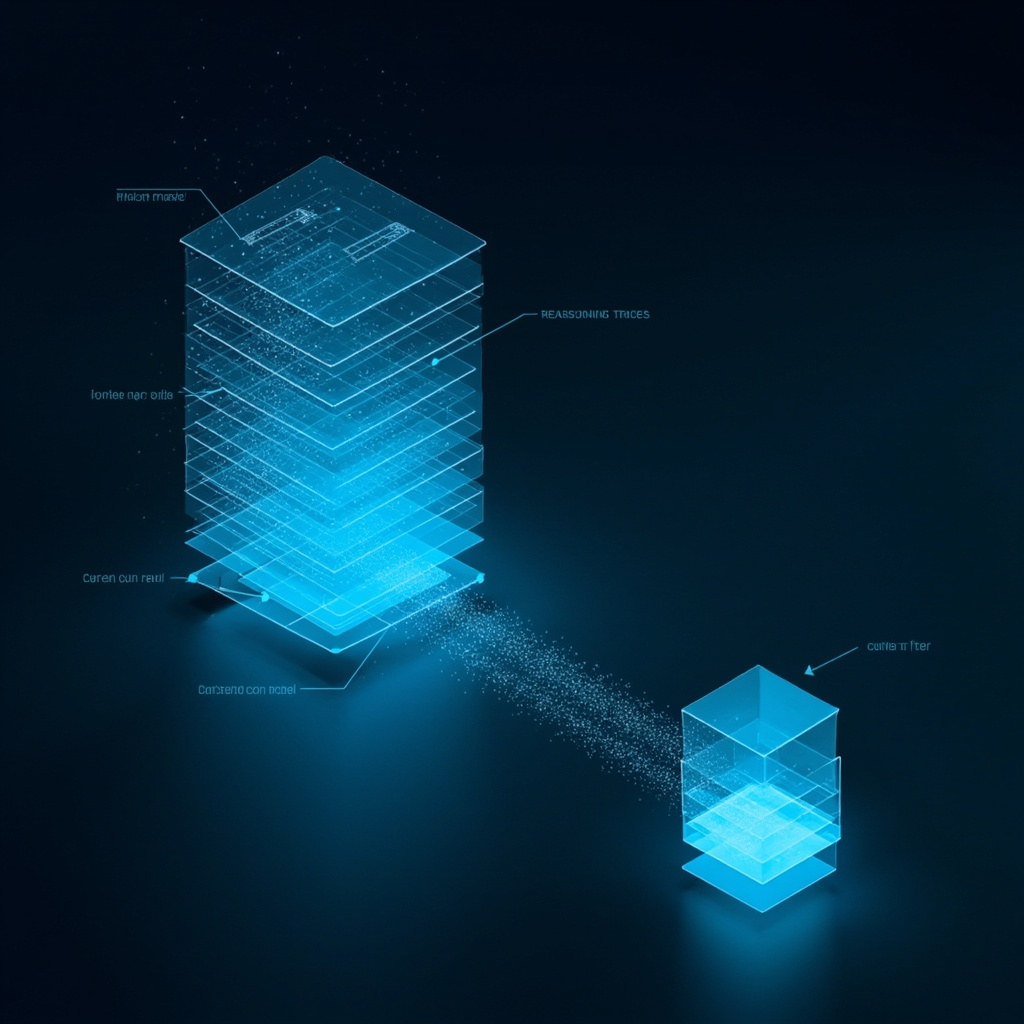
Modern pipelines look less like “small model imitates big model” and more like a continuous loop. The teacher produces candidate answers, ranked outputs, and reasoning traces. A curator — sometimes a second model, sometimes humans, often both — filters the traces that teach something useful. The student is trained on the filtered set, sometimes with reinforcement learning on top, sometimes with its own synthetic data layer. The student ships. New traces get logged in production. The cycle restarts.
This is why “small model” in late 2026 is a less useful phrase than “specific, level of capability on a defined task.” A distilled 8B model in 2026 can outperform a frontier 70B from 2024 on a narrow workflow. It can lose badly on a different one. The capability lives in the distillation recipe, the curriculum, and the post-training data — not in the parameter count.
Two practical examples that came up repeatedly in the past six months: distilling DeepSeek R1 into GPT-OSS produced models that, when fine-tuned on a domain corpus, retained surprisingly strong reasoning while cutting inference cost by an order of magnitude. And distilling Claude Sonnet into a smaller in-house model for code review reliably captures roughly 80–90% of the quality on the workflow of a review agent — but only if your distillation data includes the model’s actual reasoning traces, not just final outputs.
Why Distillation Became the Default Strategy
Three forces pushed every lab here at once. Compute economics is the first. The marginal cost of producing a frontier token dropped, but the marginal cost of producing a *good* token — meaning tokens that survive user evaluation, not just benchmarks — did not. Distillation lets a lab amortize the expensive reasoning into a cheaper model that can be served at higher margin.
Latency economics is the second. A 70B-class model at frontier quality is fine for async tasks. It is not fine for real-time voice, autocomplete, embedded IDE suggestions, or anywhere you need sub-200ms response. Distilled small models are how labs reach the latency tier where the application is feasible. The OpenAI decision to ship GPT-5.4 Nano as the default model for many code editor integrations is essentially a latency decision dressed as a capability decision.
Deployment economics is the third, and this one is structural. On-device AI, edge inference, regulated industries that need private deployments, and any consumer product that needs to work without a network — all of them need models that can run on hardware a customer actually owns. Distillation is the only path to that. Apple’s Foundation Models framework, Google’s on-device Gemma, Qualcomm’s Snapdragon NPU and the Meta-on-Rayburn edge ideas that surfaced this year — every on-device LLM story is a distillation story.
The surprising side effect: the cheaper models are not just smaller. They are also *more aligned*, in a specific sense. They have had their rough edges sanded down by the distillation pipeline, and their outputs are calibrated to the lab’s preferred response style. For builders this is a feature, not a bug — you get predictable behavior without writing a long system prompt to suppress the noise.
The New Model Hierarchy
If you internalize the late-2026 model market as just “frontier vs. cheap,” you will overpay. The real structure looks more like this:
| Tier | What it is in 2026 | When you want it |
|---|---|---|
| Frontier | The lab’s top-of-line reasoning model. Distilled from earlier generations of even larger research models. | Hard reasoning, novel research tasks, anything where the user is willing to wait and the cost per call can be high. |
| Distilled pro | A smaller model trained on the frontier’s reasoning traces. Examples: GPT-5.4 Mini, Claude Sonnet-lite, Gemini Flash. | Production workloads where quality matters but cost and latency are real constraints. The default for most APIs in 2026. |
| Distilled nano | An aggressively compressed model, often running with quantization and sparsity tricks. GPT-5.4 Nano, Claude Haiku, Phi-class models. | High-volume classification, routing, simple extraction, autocomplete, code completion, anything where you do many calls and quality per call is moderate. |
| Specialist distilled | A small model distilled on a narrow corpus for one job — code review, contract clause extraction, SQL generation, voice intent. | When you have a high-volume, well-defined job and a clear accuracy bar. Often the highest ROI per dollar. |
| Open-weight base | An open-weight model you self-host or fine-tune yourself. Llama, Mistral, Qwen, GPT-OSS, DeepSeek. | Privacy, cost ceiling, latency floor, or full control. The trade-off is operational complexity. |
The mistake builders make is treating the cheap tier as interchangeable. It is not. A distilled pro model is calibrated for a wide range of tasks. A specialist distilled model is calibrated for one. Mixing them up is why so many teams overpay for routing or underdeliver on quality.
What Actually Changed in the Last Six Months
The story moved fast in 2026. Three shifts matter for builders right now.
Distillation campaigns became a national-security story. Anthropic and OpenAI both published detailed allegations of industrial-scale distillation campaigns from Chinese labs in September 2026. Anthropic’s report named Alibaba, Moonshot AI, and DeepSeek. The follow-up reporting framed the activity as systematic and ongoing. Whether you read this as an IP story, a security story, or a competitive story depends on your angle. What matters for builders is that the cheap-tier models from these labs are now politically loaded. Some enterprise buyers are restricting which ones they can use. Some government-adjacent deployments cannot use them regardless of capability.
Self-distillation stopped being embarrassing. For two years labs quietly distilling their own models felt like admitting the frontier wasn’t pulling away fast enough. That is no longer the framing. Every major lab now publicly distills its own models, and the distillation recipe is treated as a competitive asset. The roadmap looks like this: train a giant research model, use it to produce curated traces, distill those traces into the production line, retire the giant. Anthropic’s Claude family, Google’s Gemini Flash, OpenAI’s GPT-5.4 Mini/Nano — all built this way.
The specialist-distilled economics crossed a line. Two years ago, distilling a specialist model cost so much in compute and data that only large enterprises did it. In late 2026, you can distill a competent specialist model for a narrow job with surprisingly modest budgets. Show HN posts in the past nine months include a 14MB agentic LLM for phones and wearables, on-device PrismML Bonsai models running inside DRAM, and open-source recipes for distilling GPT-OSS for specific domains. The tooling has caught up.
The Builder’s Playbook for Distillation in Late 2026
You do not need to be a frontier lab to benefit. Most builders should think of distillation as one tool among three: routing, fine-tuning, and distillation.
Step 1: Don’t distill what you cannot measure. The hardest part of any distillation project is not the training. It is the evaluation. You need an evaluation set that captures what you actually want the small model to do — not a generic benchmark. If you cannot measure the gap between current behavior and target behavior with a number, you cannot tell whether distillation helped.
Step 2: Pick the right teacher. The frontier model is rarely the right teacher. A distilled pro model, fine-tuned on your domain, is often the better teacher because its outputs are more consistent and less expensive to generate. The teacher’s job is to produce the traces you cannot. For narrow tasks, a well-prompted mid-tier model frequently beats the frontier as a teacher because its mistakes are predictable and easy to filter.
Step 3: Curate, do not just dump. The naive approach — take every teacher output and train on it — is almost never the best approach. The distilled models that work in production are trained on filtered traces: examples that the teacher got right with, high-confidence answers, cases where the reasoning was tight, cases that cover edges of your distribution. Filtering is the secret sauce.
Step 4: Use distillation as a continuous loop. The best results come from teams that treat distillation as ongoing, not one-shot. Run the small model in production. Capture the cases where it fails. Distill the fixes back into the next version. This is closer to how labs do it internally, and the gap between one-shot distillation and continuous distillation is real.
Step 5: Watch for distillation debt. There is a real failure mode where a small model inherits the teacher’s blind spots but does not have the teacher’s reasoning capability to recover from them. The model sounds confident because it was trained on confident answers. If your teacher has a known failure pattern — for example, Claude distillation producing models that lose specific safety behaviors, or DeepSeek distillates losing certain guardrails — you have to evaluate for that explicitly. The HN community has been tracking this with the term “soul stripping.” It is not a metaphor. It is a measurable degradation pattern.
What Is Worth Doing Now vs. What Is Still Overhyped
Worth doing now. If you have a high-traffic AI feature with predictable inputs, distill a specialist model for it. The unit economics in late 2026 make this a no-brainer for any workflow above a few million tokens per month. The barrier is no longer the compute. It is the evaluation discipline.
Worth doing now. Treat distillation as the default answer to “how do I make this faster and cheaper” rather than the exception. Routing was the 2024–2025 pattern. Distillation is the 2026–2027 pattern. They overlap, but the economics of distillation at scale beat routing for high-volume workflows.
Worth doing now. For consumer products, plan around on-device inference as a real deployment target, not a marketing checkbox. The hardware story caught up in 2026. The model stories that can run on that hardware are mostly distilled stories.
Still overhyped. The idea that distillation lets you skip the underlying model choice. It does not. If you distill from a teacher that is bad at your domain, you get a small model that is bad at your domain, faster. Distillation is an amplifier of good upstream decisions and a fast path for bad ones.
Still overhyped. Fully autonomous distillation loops where the model improves itself without human curation. The current generation of self-improvement stories is real, but every working version has a human in the loop for filtering, evaluation, and domain judgment. Treating self-distillation as hands-off is a fast way to drift in production.
Still overhyped. The framing that “distillation is stealing.” The technical reality is that distillation is a generic technique with many legitimate applications, and the IP argument is only interesting in specific adversarial contexts. For builders, this is mostly noise. Focus on capability and cost, not the political framing.
Common Pitfalls
Treating the cheap tier as interchangeable. Distilled pro models and specialist distilled models are different products. Use the wrong one and you either bleed tokens or miss the quality floor.
Distilling without enough variety in the training data. A common failure is distilling on a narrow slice of the teacher’s outputs and shipping a model that works on five queries and falls apart on the sixth. The fix is harder than people want: cover the long tail, not just the happy path.
Ignoring distillation debt until it bites. Distilled models lose capabilities the teacher had. If you do not evaluate for the specific losses, you ship regressions you did not notice. Build the evaluation set before the training set.
Confusing distillation with fine-tuning. Fine-tuning adjusts a model’s behavior on a domain. Distillation transfers a model’s capabilities into a smaller footprint. They overlap but are not the same. A fine-tuned small model is not automatically a distilled one, and the workflows, data, and economics are different.
Skipping productionizing. A distilled model that requires offline distillation runs a manual pipeline that nobody maintains is a model that breaks in three months. Treat the distillation pipeline like any other production system: version the data, version the model, automate the rerun, alert on drift.
When Distillation Is the Right Move vs. When It Is Not
| Use distillation when… | Skip distillation when… |
|---|---|
| You have a high-volume, well-defined workload and unit cost matters | You are still iterating on the workflow itself |
| You need latency that frontier models cannot hit | You are doing one-off, low-volume tasks where frontier quality wins |
| You need on-device or private deployment | You cannot define a stable evaluation set |
| You have a working frontier-driven version to use as a teacher | You do not yet understand what “good” looks like for this workload |
| The workflow has stable inputs and clear success signals | The use case is genuinely novel and you do not know what distribution to train on |
| You can afford the operational cost of maintaining the pipeline | You need results this week and have no appetite for a multi-week evaluation effort |
FAQ
Is distillation just for cutting cost, or does it improve capability too?
It cuts cost at the inference layer. It does not improve the underlying capability ceiling, which is set by the teacher and the data. What it can do is concentrate capability into a smaller footprint, which means a better cost-per-quality tradeoff. For narrow tasks, a well-distilled small model can outperform the frontier because it has been trained on a tighter distribution.
Do I need to train my own teacher to distill?
No. Most successful projects distill from a hosted frontier or distilled-pro API. The custom move is in how you filter, curate, and structure the training data, not in training the teacher yourself.
What is the smallest model I should consider distilling?
In late 2026, the sweet spot is roughly 1B–8B parameters for most production workloads, with 100M–500M models viable for very narrow classification and intent tasks. Below 1B, you start losing the capabilities that distillation is supposed to preserve.
How long does a distillation project actually take?
A first-pass specialist distillation typically runs two to six weeks if you have a clear evaluation set and access to teacher traces. The evaluation setup is usually the bottleneck, not the training. Continuous distillation loops run continuously, with the cycle measured in days rather than weeks.
Is open-weight distillation actually viable for production?
Yes, with caveats. Llama, Mistral, Qwen, GPT-OSS, and DeepSeek variants all support distillation workflows. The production viability depends less on the base model and more on your evaluation discipline, your deployment infrastructure, and your willingness to maintain the pipeline. For privacy-bound workloads, this is the default answer.
The Closing Thought
The model market in late 2026 is not a frontier-versus-everyone-else story. It is a layered story where every tier is, increasingly, a distillation story. The interesting question for builders is no longer “which model is the best” — it is “for this workload, at this volume, at this latency budget, which distilled model is the right answer, and what does it cost to keep that answer fresh.” That is a much more tractable question than the one we were asking in 2024, and the people who figure it out will quietly outperform the people still chasing the frontier.